Catrin Morgan - Sounds from the Other Room
2nd July -12 September, 2026
- Launch party, Thursday,16 July 6-10pm
We are delighted to present an exhibition of drawings by artist Catrin Morgan. The exhibition includes recently made works not previously exhibited alongside a selection key works from the last 15 years.
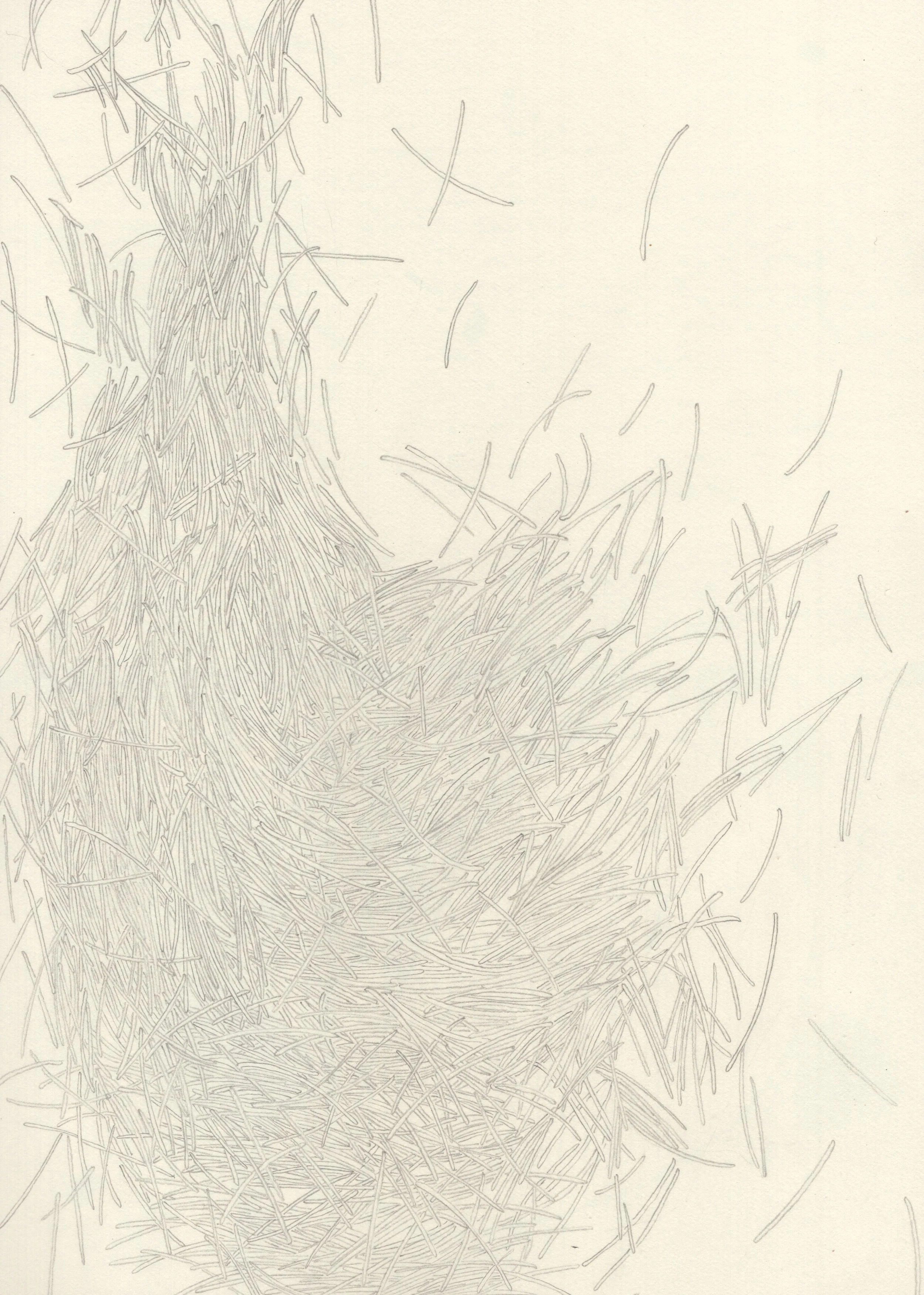
The almost imperceptibly small mark a chicken makes when it pecks the ground is a reminder that the universe is as imperceptibly minute as we think it vast. The extraordinarily delicate drawings and collages of Catrin Morgan are simultaneously vast and minute. Lines, architectural spaces, natural forms, repetition are some of visual components the artist uses to explore themes such as the unseen, the covert, secreted history and surreal interventions in the local and familiar.
Earlier work included the artist’s research on Nottingham’s own rarely seen River Leen. Through observing the river and researching its social and historic significance, Morgan reimagined the urban river that was once a key part of Nottingham’s industry as a series of drawings that at points feel bodily and diagrammatical. The artist’s drawings and animations exploring the architecture of the WWII code breaking centre at Bletchley Park and the dazzling Numbered Stations 2011 - a taxonomy of radio masts used to transfer secret coded radio broadcasts during the cold war - are both examples of Morgan’s interest in covert and secreted history. We worked in huts that were heavily disguised, 2015-17, is a partial morse code transcription of an interview with Margaret Dunkelman which the artist conducted in 2013. Margaret was recruited to Signals Intelligence (SIGINT) as a teenager and spent WWII listening to Morse Code transmissions from Europe. Morgan’s ability to visualise the hidden or obscured helps us to imagine history and perhaps interpret the present.
Counting Primes, 2016 is one of a series of sequences in which the number of elements in each picture is a prime number. This sequence represents the first 50 prime numbers (plus 1 which is not a prime). The sequence shows a bathroom constructed through a loose mathematical logic that presents multiple perspectives and seems to reveal space within spaces as the sequence unfolds. This series of works helps to view our own everyday domestic space through a different lens. These works contain a wit as the artist explores the bland and familiar domestic spaces we inhabit daily in a way that is beautiful and surreal with analytical rigour.
Eggs, 2024 are a series of drawings that imagine the inner workings of an egg. These drawings at points are almost diagrammatical and its sequence suggests a non sequential evolution. The work is inevitably linked to the artist's love of chickens, of which she lived with in her former home in upstate New York. The work celebrates the vast and complex nature of things that are familiar, seemingly ordinary, but quite remarkable.
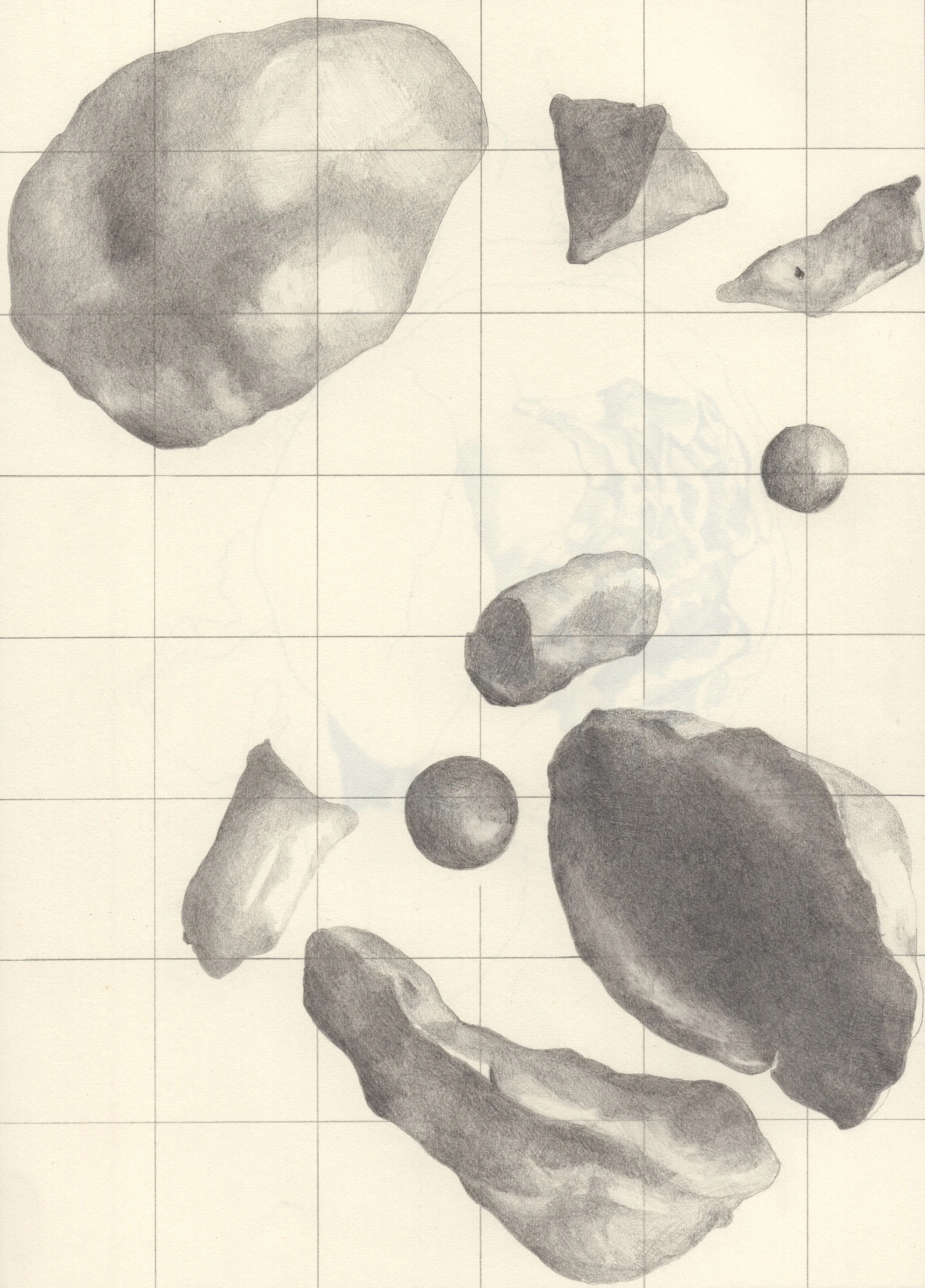
From 2018–2026 Morgan taught at The New School in New York City but lived in the remote and extraordinarily beautiful Upstate New York, an extreme contrast from the high intensity metropolis. Her home which sat on the threshold of a lake and landscape of outstanding natural beauty inevitably entered the artist’s imagination. Swamp Chunks, 2025, is an exploration of elements of a nearby pond that is constantly in a state of flux responding to seasonal changes. Like much of Morgan’s work, Swamp Chunks images what we may feel but may not be able to see. Our perception of the world resonates most strongly on the surface as we navigate our daily life, but what happens underneath the surface can be understood through analysis, observation, science and the artist’s imagination. These works have Morgan’s unmistakable sensitivity, its biomorphic qualities contrast with the diagrammatical, analytical and architectural quality that runs through much of the work.
Morgan’s work is as much at home in books as on gallery walls. The artist illustrated the significant literary work The Age of Wire and String by Ben Marcus (Granta) and Studies for Studies, an edition of 5 handmade books produced at the Women’s Studio Workshop, New York and Jerome’s Study, a collaboration with prize-winning author Max Porter.
The minute pencil marks that feel like the peck of chicken, the grids, the shifting perspectives, the geometric structures, the biomorphic forms, the pages and the sequences are just some of the elements Morgan uses to create deeply layered works, that much like their subject matter, are discreetly powerful.
Power in art is often leveraged through brassy singular statements and monuments. Morgan’s work is perhaps more like the pages of a book. A transfer and sharing of knowledge that invites the viewer to ‘read’ in detail.
Biography
Catrin Morgan is an artist and writer whose practice is concerned with mathematical, architectural, and theoretical systems. Catrin has an MA in Communication Art and Design from The Royal College of Art in London and a PhD in Visual Communication also from the RCA. Her first book, Phantom Settlements (Ditto Press, 2011), an illustrated exploration of the work of Ryan Gander, Jamie Shovlin, and Tom McCarthy, was produced in collaboration with Mireille Fauchon and the design studio Julia. Her second book, an illustrated edition of Ben Marcus’s landmark of experimental fiction, The Age of Wire and String, was published by Granta Books in 2013. In 2017 she was invited to produce a limited-edition artist’s book, Studies for Studies, at Women’s Studio Workshop in Rosendale in New York and, in 2018, Jerome’s Study, a further collaboration with the novelist Max Porter, was published by Test Centre Books in London. She was a 2022-23 GIDEST Fellow at The New School in New York and is currently undertaking a period of research and development funded by the Arts Council and the National Lottery.